The honest guide Maryland vehicle owners need before spending money on car paint — from a mobile mechanic who has seen both done right, and very, very wrong.
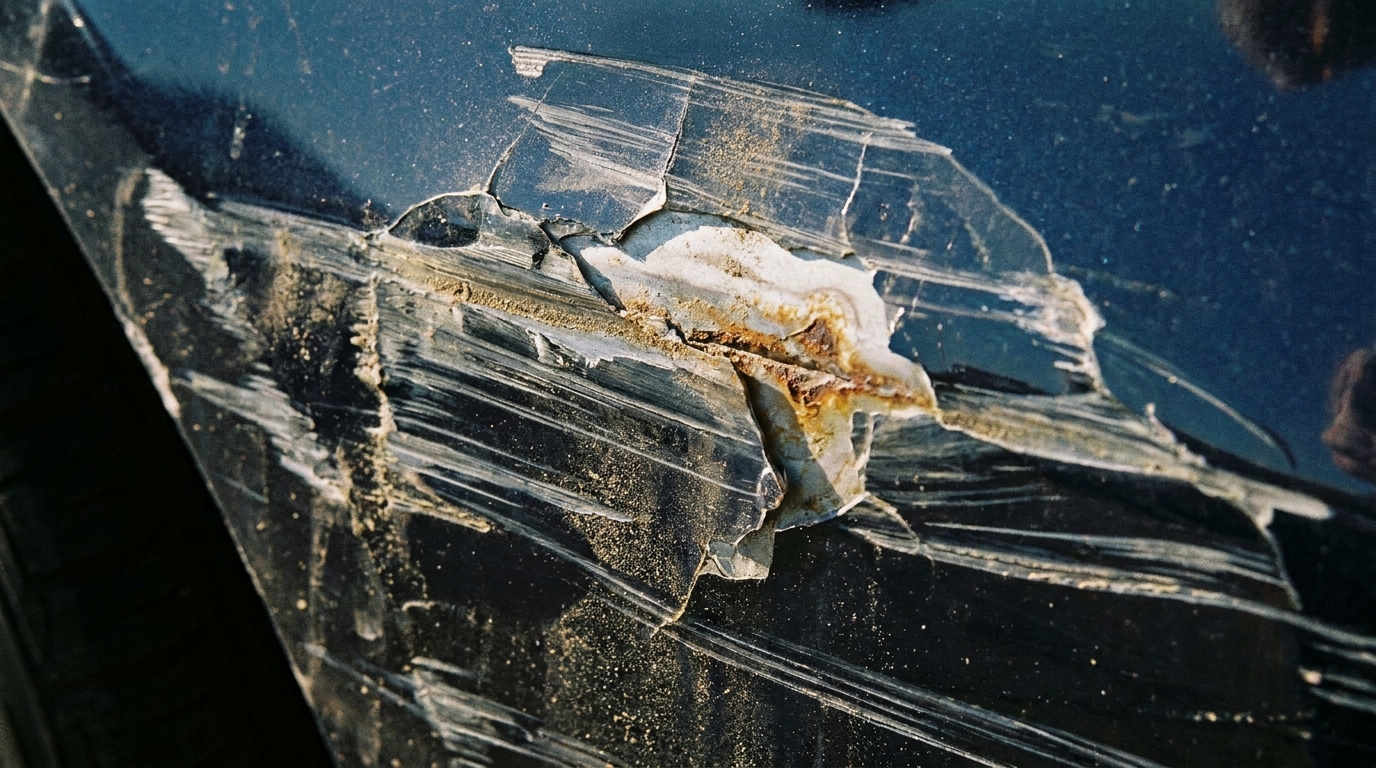
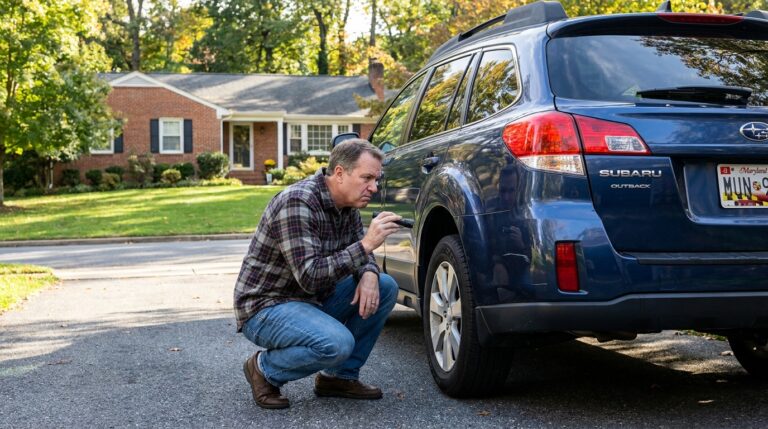
You walk out to your car in the morning. There is a scratch on the driver door — could be a shopping cart, could be someone’s key, could be that tree branch you drove past too close. It is not the end of the world. But now it is bugging you every time you look at it.
Here is the honest answer from someone who has been working on cars in Maryland for years: it depends on three things — the depth of the damage, the location on the car, and how you want your car to look in two years.
The Fingernail Test: How to Assess Your Car Paint Damage
The fingernail test: Run your fingernail across the scratch. If your nail catches in it, the scratch has gone through the clear coat and into the color layer or primer. A touch-up pen probably will not fix it. If your nail slides smoothly, you are looking at a clear coat scratch at most — and you have options.
The location check: Vertical panels (doors, quarter panels, fenders) are harder to blend touch-up on than horizontal panels (hood, trunk, roof). The paint naturally wants to sag and pool on vertical surfaces.
The rust check: If you see any brown or orange discoloration around the scratch, there is already surface rust forming. This needs to be treated before painting — either by a professional or with a dedicated rust converter product.
When a Touch-Up Pen or Kit Is the Right Choice
Touch-up paint gets a bad reputation, mostly because people use it wrong. But when it is the right tool for the job, it is genuinely the smart choice — fast, cheap, and completely adequate for the situation.
A touch-up pen or kit is the right move when:
- The damage is a single stone chip or tiny scratch (less than 2 inches total)
- The scratch is on a horizontal surface (hood, roof, trunk) where paint will not sag
- Your fingernail does NOT catch in the scratch
- There is no rust or discoloration around the damage
- The car is a daily driver and you are not planning to keep it forever
How to Actually Use a Touch-Up Pen Correctly
- Wash and dry the car first. You need a clean surface.
- Clean the scratch with isopropyl alcohol. This removes oils.
- Let the area FULLY dry. Moisture under paint causes bubbles and peeling.
- Apply in thin layers. Thin. Wait 20 minutes. Another thin layer. Never glob it on.
- Let it cure 24–48 hours before wet sanding or compounding.
- Wet sand with 2000-grit sandpaper if needed. Then compound.
Done properly, a $30 touch-up can look genuinely good from 3 feet away. Done carelessly, it will look like what it is — paint smeared on by someone who did not have the patience to do it right.
When to Call a Professional Auto Body Shop
Here is where I have to be honest: most of the time, for most people, a professional shop is the better choice — even for moderately-sized scratches.
Hire a pro when:
- Your fingernail catches in the scratch (clear coat is breached)
- You can see bare metal or primer — anything beyond clear coat
- There is any rust or corrosion around the damage
- The scratch is on a door, fender, or other vertical panel
- The damage spans more than one panel
- You are dealing with a collision result, not a parking lot scratch
- The car is a lease or financed vehicle with specific return standards
- You are filing an insurance claim
What a Professional Does That You Cannot
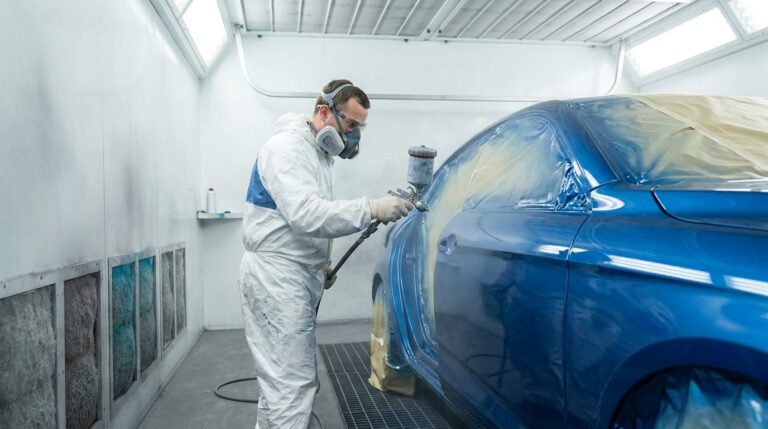
Spray equipment: A compressed air spray gun applies paint in a fine mist that rolls on at 2–4 mils thickness — thin enough to flow out evenly, thick enough to sand and level. Brushing or pen application leaves raised edges.
Controlled environment: Body shops have climate-controlled spray booths with filtered air. You cannot replicate this in a driveway.
Proper prep: This is the biggest one. A shop will sand to bare metal or proper primer, apply adhesion promoter, and ensure every surface is correctly treated before paint goes on. This is why professional paint jobs last 10–15 years while DIY jobs fail in 2–3.
Color matching: Professional shops use your vehicle OEM paint code and computer-matched formulas. They can blend into adjacent panels so the repaired area is invisible even under bright light.
Clear coat: Professional shops apply clear coat over every paint job. DIY touch-up products that skip clear coat will chalk and fade within a year in Maryland summer sun.
⚖️ Side-by-Side: DIY Touch-Up vs. Professional Paint
| Factor | DIY Touch-Up | Professional Auto Body Paint |
|---|---|---|
| Cost | $10 – $100 | $150 – $12,000 |
| Time to complete | 30 min – 2 hours | 1 day – 3 weeks |
| Skill required | Basic patience | Professional training + equipment |
| Result durability | 1–3 years typically | 10–15+ years |
| Color matching | Basic — may be noticeable | Computer-matched, invisible |
| Clear coat included | Usually no | Yes, always |
| Handles rust | No — must treat separately | Yes — part of proper prep |
| Insurance compatible | No | Yes |
| Warranty | None | Lifetime typically |
The Real Cost of Getting It Wrong
Here is a story I see at least once a month as a mobile mechanic in Maryland: Someone spent an afternoon touch-up penning a scratch on their car. It looked OK for about six months. Then the paint around the edges started lifting. Water got under it. By the following winter, the scratch had become a rust hole — and what started as a $60 touch-up had turned into a $900 panel refinish that might have been avoided.
The irony is they were trying to save money. The extra $200–$300 to have it done right at a body shop would have been the cheaper choice over 18 months. This is not an argument against all DIY touch-ups. It is an argument for honest self-assessment before you start.
🩹 Six Real Scenarios: What Would You Recommend?
1. Someone keyed my car in the parking lot. 4-inch scratch on my driver door.
Professional. Period. A single-panel refinish at a Westminster body shop will cost $250–$400 and will look perfect. A touch-up pen will look like someone tried to hide a crime.
2. A rock hit my hood on I-70. Small chip, maybe a quarter-inch.
Touch-up pen is fine here. Small chips on horizontal surfaces respond well to pen application. Clean, dry, thin layers, let it cure. Done right, it will look 90% better and hold up fine for a few years.
3. My clear coat is peeling. The whole hood looks chalky.
Professional, full clear coat restoration or respray. Once clear coat is actively peeling, no amount of touch-up paint will fix it. Budget $400–$1,500.
4. I backed into a pole. The bumper is scraped but not cracked.
Usually professional bumper refinish ($300–$750). Bumper scrapes often look minor but usually need proper prep to not look worse after painting.
5. My car was in a fender bender. The insurance is handling it.
100% professional. Do not try to save money by going around the insurance process for collision damage. Use a reputable body shop that works with insurance directly.
6. It is an old Civic with 180,000 miles. I am not putting money into it.
DIY touch-up at most, or leave it. A $40 touch-up pen can slow down further rust development. But if the scratch does not bother you, it probably does not need fixing.
🌡️ Maryland-Specific Considerations for Paint Decisions
Road salt: If you are in Westminster, Carroll County, or anywhere that gets heavy salting in winter, any paint damage is effectively a future rust problem. Salt will find its way under DIY paint within 2–3 winters. A professional job with proper rust treatment is worth every dollar.
Sun exposure: Maryland summers are genuinely hot and sunny. UV exposure causes clear coat to oxidize and fail. DIY products without proper UV inhibitors fail faster here. Use automotive touch-up products — not hardware store spray paint.
Maryland inspection requirements: Maryland requires annual vehicle inspections, and body damage that affects safety systems may be flagged. If your paint damage is related to collision or structural issues, a professional repair (and documentation) may be necessary for registration renewal.
❓ Auto Body Paint vs. Touch-Up — FAQ
Can I use hardware store spray paint on my car?
Please do not. Hardware store paints are not formulated for automotive finishes. They will chalk and fade within months, and they will make a professional repair harder if you eventually go that route.
Will a touch-up pen void my car’s warranty?
Not on its own. However, if the touch-up fails and causes rust that spreads, some warranties may not cover the resulting corrosion.
How long does professional auto body paint take?
A single panel: 1–3 days. A full respray: 10–21 days. Most Westminster-area shops can give you a timeline estimate on the same day they inspect the car.
Is a professional paint job worth it for a car with 100,000+ miles?
It depends on your plans. If you are keeping the car 3+ more years, yes — a quality paint job preserves the value and protects the body from further corrosion.
What if I cannot afford a professional paint job right now?
A clean touch-up with a quality pen (Dr. ColorChip, TESLAY, or similar) buys you 1–2 years of protection while you save. In the meantime, wax the car regularly to slow further oxidation.
🔗 Related Services from Auto Tools Mart
- Mobile Mechanic Services — Reisterstown, MD
- Dash Cam Installation in Maryland
- GPS Tracker Installation
- Mobile Battery Testing & Replacement
- Roadside Assistance — Jump Starts, Lockouts, Fuel Delivery
Need a referral to a trusted auto body shop in Westminster? Call Auto Tools Mart: (443) 555-0192
Auto Tools Mart — Reisterstown, Maryland | Proudly serving Westminster, Carroll County & all of Maryland | autotoolsmart.com